Call Us

Multi-brand solar, battery and water heating solutions for homes and businesses across Trivandrum and Kollam.
Call Us
Send Email
Location
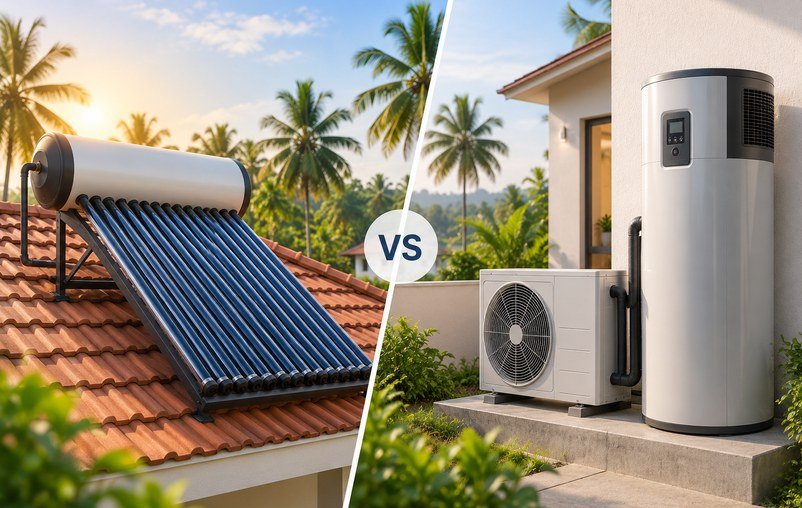
Both cut the cost of hot water dramatically compared with an electric geyser, and both are worth having. They fail in different conditions, though, and that is what should decide between them.
A solar water heater collects heat directly from sunlight. V-Guard systems use evacuated tube collectors - triple-coated borosilicate glass tubes that absorb diffuse solar radiation, not just direct sun. A heat pump does something different: it moves heat from the surrounding air into the water rather than generating it electrically. It uses electricity, but only to run the pump, not to heat.
A solar water heater has essentially no running cost while the sun is out. A heat pump delivers 4.4 or more units of heating for every unit of electricity consumed, which works out at up to 75% lower running cost than a conventional electric geyser. So the solar heater wins on cost, but only when conditions allow.
This is where they separate. Evacuated tube collectors keep working on overcast days because they absorb diffuse radiation, and for prolonged monsoon spells an optional ISI-marked electric backup heater covers the gap. A heat pump does not care about sunlight at all - V-Guard units are engineered to run from −15°C to 43°C, so supply holds through the heaviest monsoon without switching to backup.
If your hot water demand is domestic and fairly predictable, and you have unshaded roof space, a solar water heater is usually the better economics. If you need hot water that never depends on the weather - or you are heating for a hotel, hospital, hostel or swimming pool where demand runs day and night - a heat pump is the more dependable answer. Many properties end up with a solar heater for the household and a heat pump where continuity matters.
 Daily hot water demand in litres, not guessworkWhether the roof has genuinely unshaded space through the dayWater hardness - V-Guard tanks use SS 304-L with a sacrificial magnesium anode, and 58 mm tubes resist the scaling that clogs narrow copper pipesWhether you need supply during long monsoon spells
More on solar water heaters and geysers, heat pump water heaters, or ask us which suits your property.