Call Us

Multi-brand solar, battery and water heating solutions for homes and businesses across Trivandrum and Kollam.
Call Us
Send Email
Location
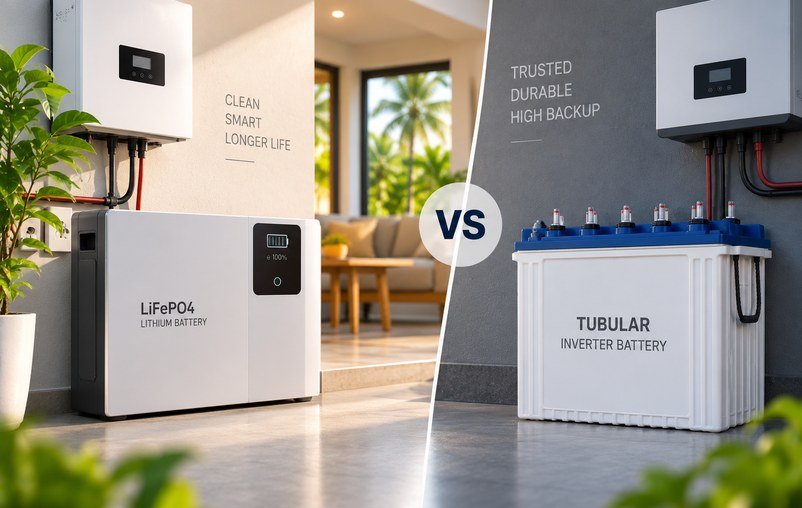
This is the question we get asked most often, and the honest answer is that both are still the right choice for different homes. Here is how they actually differ.
This is the widest gap. A LiFePO4 lithium battery lasts up to 10,000 cycles. A traditional lead-acid battery manages roughly 600. That is about fifteen times the working life, and it is the single biggest reason lithium costs more up front and less over its lifetime.
A lithium battery recharges fully in three to four hours instead of ten to twelve, while drawing 56% less electricity than an equivalent lead-acid setup. In an area with frequent short power cuts, that matters more than it sounds - a slow-charging battery may not be back to full before the next outage.
Lithium needs none. V-Guard tubular batteries use LMLA - Low Maintenance Lead Acid - construction that cuts water loss, so distilled water is needed only once every eight to ten months rather than monthly. That is a genuine improvement on older flat-plate batteries, but it is still a task you have to remember.
Long outages. V-Guard tubular batteries are C10-rated, meaning they are designed to deliver their full rated capacity over a ten-hour discharge. C20-rated batteries quote their capacity over twenty hours, which flatters the number and suits shorter, lighter loads. If your power cuts run for hours during the monsoon and you are backing up heavy loads, a C10 tubular battery in the 40Ah to 200Ah range is built for exactly that.
 Frequent short cuts, want it fitted and forgotten - lithiumLong monsoon outages, heavy loads, lower up-front spend - C10 tubularNo space for maintenance access, or a first-floor install - lithiumEither way, size the battery to the load, not to the budget
V-Guard Multi-Ion inverters run both lead-acid and lithium chemistries, so choosing tubular today does not lock you out of moving to lithium when the battery is eventually replaced.
More on inverters and lithium batteries, tubular inverter batteries, or get a recommendation for your load.